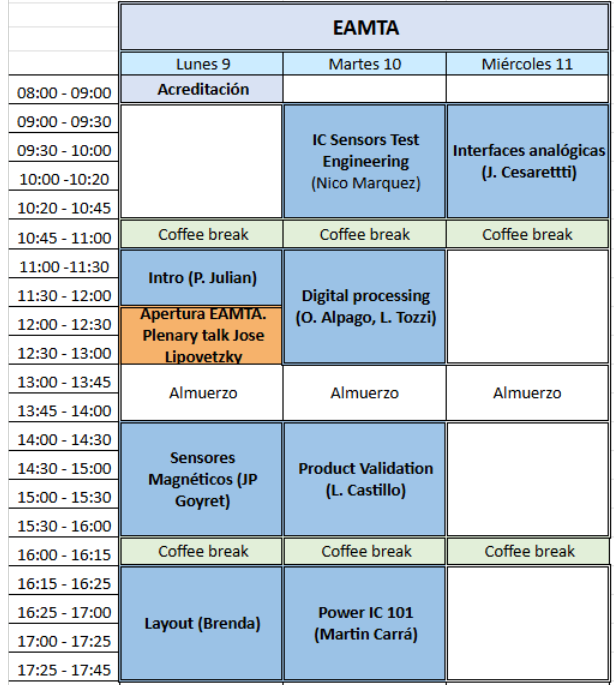
By the end of the course, the students will have achieved a basic understanding of magnetic sensors, their main characteristics and challenges, and the complete development chain, from the sensor to the digital output.
In the first part, the concepts of the HDL Verilog language are reviewed and the basic elements of digital design are presented: Combinational circuits and sequential circuits.
During the second part, the concepts of timing and gate and signal delays are addressed in order to understand how to properly design a digital circuit. The importance of a correct design is demonstrated, not only from the logic point of view, but also from the time domain, that is to make it work efficiently or, in our case, fast enough to satisfy the requirements of the application.
In the third part, a synchronous circuit will be simulated and implemented on an FPGA. During this process it will be verified that all constraints are met and finally its logic operation will be validated.
Description
This 300-minute course/seminar is aimed at providing basic knowledge about integrated magnetic sensors and their applications in various fields. The course gives an introduction to Hall effect and magneto-resistance sensors, different aspects of layout of the sensors and their associated circuitry, a description of analog interfaces and their constraints and characteristics, digital filter and processing architectures commonly used, and finally verification and testing setups.
In the first part, the concepts of the HDL Verilog language are reviewed and the basic elements of digital design are presented: Combinational circuits and sequential circuits.
During the second part, the concepts of timing and gate and signal delays are addressed in order to understand how to properly design a digital circuit. The importance of a correct design is demonstrated, not only from the logic point of view, but also from the time domain, that is to make it work efficiently or, in our case, fast enough to satisfy the requirements of the application.
In the third part, a synchronous circuit will be simulated and implemented on an FPGA. During this process it will be verified that all constraints are met and finally its logic operation will be validated.
Minimum content
Magnetic Sensors and Hall effect (120 min) Digital Processing (120 min) Validation and Testing (120 min) Layout (120 min) Analog Interfaces (120 min) Power IC applications (120 min)
In the first part, the concepts of the HDL Verilog language are reviewed and the basic elements of digital design are presented: Combinational circuits and sequential circuits.
During the second part, the concepts of timing and gate and signal delays are addressed in order to understand how to properly design a digital circuit. The importance of a correct design is demonstrated, not only from the logic point of view, but also from the time domain, that is to make it work efficiently or, in our case, fast enough to satisfy the requirements of the application.
In the third part, a synchronous circuit will be simulated and implemented on an FPGA. During this process it will be verified that all constraints are met and finally its logic operation will be validated.
Minimum content
Introduction to Verilog.
Combinational and sequential circuits.
Binary, fixed point and floating point representation.
Time diagrams of combinational and sequential circuits.